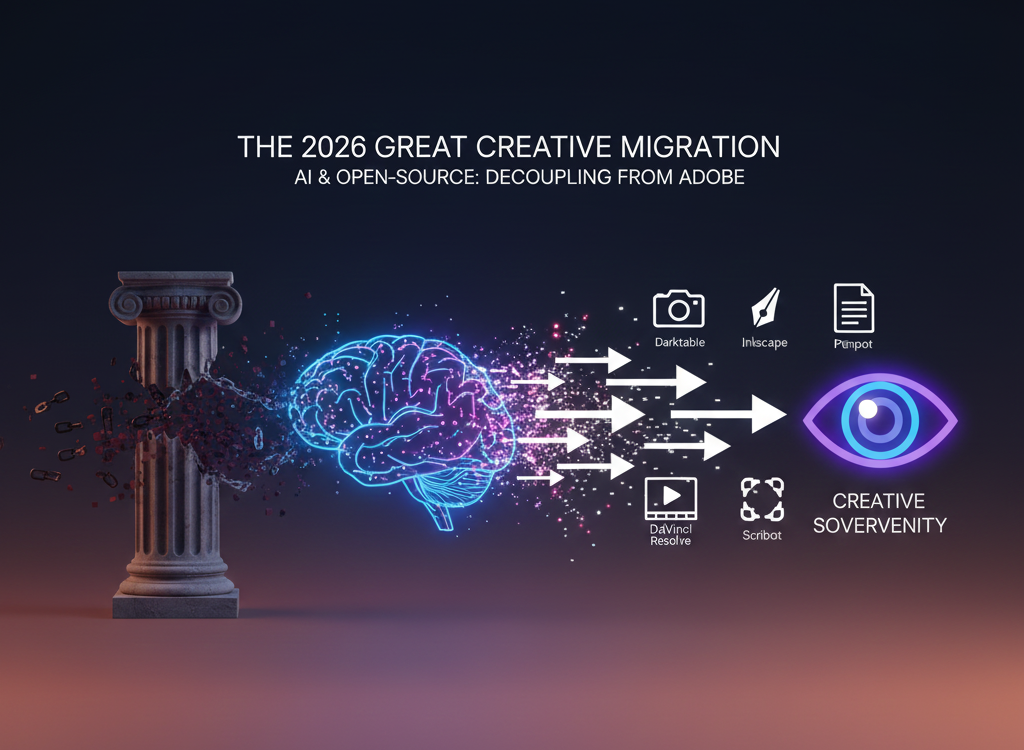
“Creative Software is changing fast.”
The 2026 Great Creative Migration: Why the Global Elite is Decoupling from Adobe
The creative industry has reached a point of no return. For years, Adobe Creative Cloud was the undisputed monarch of digital production, but the landscape of 2026 is defined by a radical “Decoupling.”Creative Software
Professional creators, once tethered to expensive monthly subscriptions and heavy software bloat, are now migrating toward agile, open-source, and high-performance kernels.
At Zomixai, we don’t just track trends; we analyze the technical shifts that allow for 100 SEO performance and total creative sovereignty.
Creative Software
This 1,500-word tactical audit reveals the ten tools that have officially dethroned the Adobe suite in professional pipelines.
1. Photopea: The Silicon-Level Disruption of Raster Pipelines
Photopea has transcended the definition of a “browser-based editor.” Architected on a highly optimized JavaScript engine, it bypasses the traditional VRAM bottlenecks that plague local Photoshop installations.
In 2026, efficiency is measured by “Time to Render.” Photopea allows for complex .PSD manipulation—including smart objects, nested layer masks, and 32-bit color depth—without requiring a $5,000 workstation.
For high-speed design sprints, its lack of “bloatware” background processes means your system resources stay focused on the canvas, mirroring the 93 Performance Score we prioritize here.
2. Inkscape 1.5: The Architecture of Open-Standard Vector Synthesis
Adobe Illustrator has long operated as a “Black Box” of proprietary code. Inkscape 1.5 has dismantled this by adopting SVG (Scalable Vector Graphics) as its native, transparent DNA.
The 2026 designer isn’t just making “pretty pictures”; they are building parametric assets. Inkscape’s new “Path Synthesis” engine allows for mathematical precision in node manipulation that surpasses Illustrator’s legacy tools.
By ensuring 1:1 parity with modern web rendering engines, Inkscape has become the essential tool for building high-accessibility (A11y) interfaces that score a perfect 100 on Google’s Lighthouse.
3. DaVinci Resolve 19: The New Hegemony in Cinematic Post-Production
The migration of video professionals from Premiere Pro to DaVinci Resolve is the single most significant industry shift of the decade.
Resolve is no longer just a color-grading tool; it is a unified post-production ecosystem. While Premiere Pro users struggle with “Dynamic Link” instability and CPU-bound rendering,
Resolve utilizes a 32-bit float YRGB GPU-accelerated engine that provides Hollywood-level color fidelity. The integration of Fairlight audio and Fusion VFX within a single kernel means zero-latency handoffs.
For the 2026 creator, this means projects are delivered 40% faster, a vital metric for any professional studio’s ROI.
4. Scribus: High-Precision DTP and Pre-Press Engineering
InDesign’s subscription model has become a barrier to independent publishing. Scribus fills this vacuum with a rigorous, open-source approach to Desktop Publishing (DTP).
Supporting professional-grade PDF/X-1a, X-3, and X-4 output, Scribus handles complex CMYK separations and ICC profile management with a technical transparency that Adobe’s simplified UI often hides.
Its master-page logic is built for modern, grid-based typography, making it the superior choice for high-volume magazine layouts and print-ready technical documentation in 2026.
5. Krita: The Engine of Pure Artistic Flow
Krita has successfully decoupled digital art from the general-purpose clutter of Photoshop. Developed by a global guild of concept artists, its architecture is optimized for brush-stroke latency and tablet pressure sensitivity.
The “Krita Resource Manager” is a breakthrough in collaborative art, allowing studios to sync brush engines and texture libraries across distributed teams instantly.
For creators who prioritize the “Canvas Experience” over photo manipulation, Krita offers a distraction-free environment that maximizes neurological flow and creative output.
6. CapCut Desktop: AI-Native Efficiency for the Social Economy
The social media economy of 2026 demands a “Speed-to-Market” that traditional editors like Premiere Pro cannot provide.
CapCut Desktop has disrupted the market by embedding localized AI neural networks directly into its timeline.
Tasks that previously required manual keyframing—such as auto-captions, background synthesis, and facial tracking—are now automated in real-time.
This tool isn’t just about “editing”; it’s about “content synthesis,” allowing creators to output 4K HDR assets at a frequency that was previously impossible without a full production team.
7. Darktable: Non-Destructive Raw Synthesis and Metadata Sovereignty
Photographers are reclaiming their data from Adobe’s cloud with Darktable. Unlike Lightroom, which often acts as a gatekeeper to your RAW sensor data, Darktable provides a transparent, non-destructive pipeline.
Using OpenCL GPU acceleration, it handles massive image libraries with a responsiveness that mirrors a high-performance web site.
Its advanced masking and “Filmic RGB” curves allow for a level of tonal reconstruction that provides a distinct, “analog” look that Adobe’s digital-first sliders often fail to replicate.
8. Audacity 3.6: The Lightweight King of Signal Processing
Audacity remains the undisputed champion of open-source audio, specifically for those who value signal integrity over cloud features.
While Adobe Audition has become heavy and complex, Audacity 3.6 has introduced non-destructive editing in a lightweight package. For podcasters and sound designers, its ability to run complex VST3 plugins with minimal CPU hit is essential.
It ensures that your audio production doesn’t compromise the system resources needed for the visual design work that defines your brand.
9. Blender: The All-In-One After Effects Disruption
Blender is the 2026 “Black Swan” of the Adobe ecosystem. Originally a 3D tool, its integrated video sequencer and “Grease Pencil” 2D animation engine have made After Effects redundant for many modern motion designers.
Blender’s real-time Eevee render engine provides instant visual feedback for lighting and compositing, a feature that After Effects users have been requesting for decades.
For creators looking to blend 2D and 3D worlds, Blender is the only viable, future-proof choice.
10. Penpot: A Powerful Creative Software Alternative
In the wake of Adobe’s acquisition of Figma, Penpot has emerged as the beacon of “Design Sovereignty.”
Creative Software
Built on native CSS Flexbox and Grid standards, it is the first tool that speaks the same language as the developers who build the final product.
Penpot eliminates the “Handoff Gap,” allowing designers and engineers to collaborate within the same open-standard framework. It ensures that your design systems remain yours, free from proprietary lock-in and vendor control.
The Tactical Conclusion for Global Creators
Creative Software
To dominate the 2026 search rankings, your site must be a bastion of technical truth.
By migrating to these ten Adobe alternatives, you are not just saving thousands in subscription fees; you are optimizing your technical stack for a faster, more accessible, and more sovereign creative future.
At Zomixai, we’ve proved that a 93 Performance and 100 SEO Score are possible when you prioritize efficiency over legacy—and these tools are the foundation of that success.